Tuesday, February 5, 2013

Gluten-Free, Whether You Need It or Not


Eat no wheat.


That is the core, draconian commandment of a gluten-free diet, a prohibition that excises wide swaths of American cuisine — cupcakes, pizza, bread and macaroni and cheese, to name a few things.

For the approximately one-in-a-hundred Americans who have a serious condition called celiac disease, that is an indisputably wise medical directive.

Now medical experts largely agree that there is a condition related to gluten other than celiac. In 2011 a panel of celiac experts convened in Oslo and settled on a medical term for this malady: non-celiac gluten sensitivity.

What they still do not know: how many people have gluten sensitivity, what its long-term effects are, or even how to reliably identify it. Indeed, they do not really know what the illness is.

The definition is less a diagnosis than a description — someone who does not have celiac, but whose health improves on a gluten-free diet and worsens again if gluten is eaten. It could even be more than one illness.

“We have absolutely no clue at this point,” said Dr. Stefano Guandalini, medical director of the University of Chicago’s Celiac Disease Center.

Kristen Golden Testa could be one of the gluten-sensitive. Although she does not have celiac, she adopted a gluten-free diet last year. She says she has lost weight and her allergies have gone away. “It’s just so marked,” said Ms. Golden Testa, who is health program director in California for the Children’s Partnership, a national nonprofit advocacy group.

She did not consult a doctor before making the change, and she also does not know whether avoiding gluten has helped at all. “This is my speculation,” she said. She also gave up sugar at the same time and made an effort to eat more vegetables and nuts.

Many advocates of gluten-free diets warn that non-celiac gluten sensitivity is a wide, unseen epidemic undermining the health of millions of people. They believe that avoiding gluten — a composite of starch and proteins found in certain grassy grains like wheat, barley and rye — gives them added energy and alleviates chronic ills. Oats, while gluten-free, are also avoided, because they are often contaminated with gluten-containing grains.

Others see the popularity of gluten-free foods as just the latest fad, destined to fade like the Atkins diet and avoidance of carbohydrates a decade ago.

Indeed, Americans are buying billions of dollars of food labeled gluten-free each year. And celebrities like Miley Cyrus, the actress and singer, have urged fans to give up gluten. “The change in your skin, physical and mental health is amazing!” she posted on Twitter in April.

For celiac experts, the anti-gluten zeal is a dramatic turnaround; not many years ago, they were struggling to raise awareness among doctors that bread and pasta can make some people very sick. Now they are voicing caution, tamping down the wilder claims about gluten-free diets.

“It is not a healthier diet for those who don’t need it,” Dr. Guandalini said. These people “are following a fad, essentially.” He added, “And that’s my biased opinion.”

Nonetheless, Dr. Guandalini agrees that some people who do not have celiac receive a genuine health boost from a gluten-free diet. He just cannot say how many.

As with most nutrition controversies, most everyone agrees on the underlying facts. Wheat entered the human diet only about 10,000 years ago, with the advent of agriculture.

“For the previous 250,000 years, man had evolved without having this very strange protein in his gut,” Dr. Guandalini said. “And as a result, this is a really strange, different protein which the human intestine cannot fully digest. Many people did not adapt to these great environmental changes, so some adverse effects related to gluten ingestion developed around that time.”

The primary proteins in wheat gluten are glutenin and gliadin, and gliadin contains repeating patterns of amino acids that the human digestive system cannot break down. (Gluten is the only substance that contains these proteins.) People with celiac have one or two genetic mutations that somehow, when pieces of gliadin course through the gut, cause the immune system to attack the walls of the intestine in a case of mistaken identity. That, in turn, causes fingerlike structures called villi that absorb nutrients on the inside of the intestines to atrophy, and the intestines can become leaky, wreaking havoc. Symptoms, which vary widely among people with the disease, can include vomiting, chronic diarrhea or constipation and diminished growth rates in children.

The vast majority of people who have celiac do not know it. And not everyone who has the genetic mutations develops celiac.

What worries doctors is that the problem seems to be growing. After testing blood samples from a century ago, researchers discovered that the rate of celiac appears to be increasing. Why is another mystery. Some blame the wheat, as some varieties now grown contain higher levels of gluten, because gluten helps provide the springy inside and crusty outside desirable in bread. (Blame the artisanal bakers.)

There are also people who are allergic to wheat (not necessarily gluten), but until recently, most experts had thought that celiac and wheat allergy were the only problems caused by eating the grain.

For 99 out of 100 people who don’t have celiac — and those who don’t have a wheat allergy — the undigested gliadin fragments usually pass harmlessly through the gut, and the possible benefits of a gluten-free diet are nebulous, perhaps nonexistent for most. But not all.

Anecdotally, people like Ms. Golden Testa say that gluten-free diets have improved their health. Some people with diseases like irritable bowel syndrome and arthritis also report alleviation of their symptoms, and others are grasping at gluten as a source of a host of other conditions, though there is no scientific evidence to back most of the claims. Experts have been skeptical. It does not make obvious sense, for example, that someone would lose weight on a gluten-free diet. In fact, the opposite often happens for celiac patients as their malfunctioning intestines recover.

They also worried that people could end up eating less healthfully. A gluten-free muffin generally contains less fiber than a wheat-based one and still offers the same nutritional dangers — fat and sugar. Gluten-free foods are also less likely to be fortified with vitamins.

But those views have changed. Crucial in the evolving understanding of gluten were the findings, published in 2011, in The American Journal of Gastroenterology, of an experiment in Australia. In the double-blind study, people who suffered from irritable bowel syndrome, did not have celiac and were on a gluten-free diet were given bread and muffins to eat for up to six weeks. Some of them were given gluten-free baked goods; the others got muffins and bread with gluten. Thirty-four patients completed the study. Those who ate gluten reported they felt significantly worse.

That influenced many experts to acknowledge that the disease was not just in the heads of patients. “It’s not just a placebo effect,” said Dr. Marios Hadjivassiliou, a neurologist and celiac expert at the University of Sheffield in England.

Even though there was now convincing evidence that gluten sensitivity exists, that has not helped to establish what causes gluten sensitivity. The researchers of the Australian experiment noted, “No clues to the mechanism were elucidated.”

What is known is that gluten sensitivity does not correlate with the genetic mutations of celiac, so it appears to be something distinct from celiac.

How widespread gluten sensitivity may be is another point of controversy.

Dr. Thomas O’Bryan, a chiropractor turned anti-gluten crusader, said that when he tested his patients, 30 percent of them had antibodies targeting gliadin fragments in their blood. “If a person has a choice between eating wheat or not eating wheat,” he said, “then for most people, avoiding wheat would be ideal.”

Dr. O’Bryan has given himself a diagnosis of gluten sensitivity. “I had these blood sugar abnormalities and didn’t have a handle where they were coming from,” he said. He said a blood test showed gliadin antibodies, and he started avoiding gluten. “It took me a number of years to get completely gluten-free,” he said. “I’d still have a piece of pie once in a while. And I’d notice afterwards that I didn’t feel as good the next day or for two days. Subtle, nothing major, but I’d notice that.”

But Suzy Badaracco, president of Culinary Tides, Inc., a consulting firm, said fewer people these days were citing the benefits of gluten-free diets. She said a recent survey of people who bought gluten-free foods found that 35 percent said they thought gluten-free products were generally healthier, down from 46 percent in 2010. She predicted that the use of gluten-free products would decline.

Dr. Guandalini said finding out whether you are gluten sensitive is not as simple as Dr. O’Bryan’s antibody tests, because the tests only indicate the presence of the fragments in the blood, which can occur for a variety of reasons and do not necessarily indicate a chronic illness. For diagnosing gluten sensitivity, “There is no testing of the blood that can be helpful,” he said.

He also doubts that the occurrence of gluten sensitivity is nearly as high as Dr. O’Bryan asserts. “No more than 1 percent,” Dr. Guandalini said, although he agreed that at present all numbers were speculative.

He said his research group was working to identify biological tests that could determine gluten sensitivity. Some of the results are promising, he said, but they are too preliminary to discuss. Celiac experts urge people to not do what Ms. Golden Testa did — self-diagnose. Should they actually have celiac, tests to diagnose it become unreliable if one is not eating gluten. They also recommend visiting a doctor before starting on a gluten-free diet.

Crash Injuries End Vonn’s Season, but Not Her Hopes


SCHLADMING, Austria — The Olympic champion Lindsey Vonn, whose record-breaking ski racing career has frequently mixed stirring triumph with frightening spills, tore two knee ligaments in a tumbling crash Tuesday and will need reconstructive surgery. Vonn fell in the super-G of the Alpine world championships, a race contested one year and two days before the scheduled start of the Sochi Olympics in Russia.


Vonn, who has won the World Cup overall title four times and has more World Cup victories than any other American, is the defending Olympic downhill gold medalist. Her right knee bent awkwardly as she landed a jump before she somersaulted down the mountain.

According to the United States ski team’s medical director, Kyle Wilkens, Vonn tore the anterior cruciate ligament and medial collateral ligament in her right knee, and sustained a tibial fracture. The team announced she would miss the rest of this season but was expected to return to racing for the 2013-14 World Cup season, which begins in October, and the 2014 Olympics.

Recovery times for reconstructive knee operations vary greatly, but numerous ski racers with multiple ligament tears have returned to the slopes in less than a year — although with mixed results.

Dr. Tom Hackett, an orthopedic surgeon at the Steadman Clinic in Vail, Colo., which has treated many top ski racers, seemed optimistic about Vonn’s Olympic prospects.

“There’s a very good chance she could return at full force,” said Hackett, who is a team physician with the United States Ski and Snowboard Association but who was not briefed on the precise details of Vonn’s injury or her treatment. “Typically, the A.C.L. alone will keep her out six to eight months, at least at the high, intense level of skiing she’s used to. The M.C.L. can often heal on its own. And a fracture with an A.C.L. is commonly a minor component.

“Each case has variables, and they will likely take more tests before there is a real treatment plan. But we’ve had a lot of skiers and snowboarders come back in a year and do very well.”

Tuesday’s race, the first of the world championships, was delayed nearly four hours because of fog. There were more than 10 separate delays as officials struggled to get the race in with daylight fading. Vonn led through the first timed stage of the race; by the second stage, she was trailing the eventual winner, Tina Maze of Slovenia, by 12-hundredths of a second.

About 42 seconds into her run, as Vonn made a right-footed turn and arced her skis to the left, she navigated a jump at the same time. Vonn soared above the snow a little off balance with her hands behind her torso rather than in front of her chest, which usually ensures a more stable landing.

Returning to the snow, her right leg splayed briefly to the right and her knee hyperextended inward and toward the left. She pitched forward at the same time and began to flip forward. Her right ski came off, cartwheeling down the slope after her. Vonn came to a stop a few hundred feet down the slope without making contact with the protective fencing, though she did plow through a gate. She was attended by medical personnel for 12 minutes on the side of the trail and airlifted to a hospital.

Vonn missed several weeks of World Cup racing after an intestinal illness hospitalized her in November. After some lackluster performances, she took an extended break from the circuit in mid-December. But she returned about a month later, winning a downhill race Jan. 19 and a giant slalom race the next week.

“I’m really sorry for Lindsey, who took a too-direct line,” said Maze, who watched Vonn’s fall. “I regret her dreadful crash.”

Lara Gut of Switzerland finished second, 0.38 of a second behind Maze. Julia Mancuso of the United States was third, 0.52 back. Mancuso called it “by far the most difficult race in my career.”

Mancuso added: “It was not great conditions on top. It was really soft and the fog started to come, and I didn’t see much.”

Chip White, the coach of the United States ski team, did not question the decision to start the race, which is the first of multiple races across several days.

“It was tough conditions; everybody had it the same,” White said. “Everyone had to wait. Everyone was at the ready for hours on end. It was a difficult situation, but everyone had to deal with the same thing.”

Atle Skaardal, the chief race director, said he saw no reason to delay the race a day.

“There were no problems with the visibility, and the course was also in good shape,” Skaardal said. “So I don’t see that any outside factors played a role in this accident.”

Other top contenders also failed to complete the course, among them Anna Fenninger of Austria and Maria Höfl-Riesch of Germany, who was the skier after Vonn. A course worker fell before Vonn’s run and had to be airlifted off the mountain as well.

Vonn sustained a concussion that sidelined her during the world championships two years ago. She also had a spectacular, harrowing crash days before the 2006 Turin Olympics. With a severely bruised back, she competed days later but did not win a medal. Vonn injured her thumb and broke a finger in a crash in the 2010 Vancouver Olympics, when she also won a bronze medal in the super-G. Those Olympics began with the prospect of Vonn’s not competing because of a shin injury she disclosed days before the start of the Games.

Bill Pennington contributed reporting from New York.
This article has been revised to reflect the following correction:

Correction: February 5, 2013


An earlier version of this article misidentified the event in which Lindsey Vonn won a bronze medal at the 2010 Vancouver Olympics. It was the super-G, not the combined.

IHOP gives away free pancakes for charity Tuesday


Early bird today gets the pancakes. A stack of them. For free from IHOP.


And it's all in the name of charity. The restaurant chain is trying to encourage diners taking advantage of the complimentary meal to donate $3 million to the Children’s Miracle Network Hospitals, which raises funds for 170 nonprofit children’s medical centers.

The company, owned by Applebee’s parent DineEquity in Glendale, has been hosting the giveaway for eight years and has raised $10 million.

The more than 1,500 IHOP restaurants will offer a complimentary tower of buttermilk pancakes from 7 a.m. to 10 p.m. IHOP has dubbed Feb. 5 to be National Pancake Day -- a holiday it says is based on a tradition several centuries old of making pancakes to use up all the dairy products forbidden during Lent.

Miss America 2013 Mallory Hagan is scheduled to help flip and serve pancakes at a Hollywood IHOP location Tuesday.

Other food-service chains have recently begun to test business models that include do-gooding.
The Panera Foundation, an offshoot of the popular sandwich company, now has five "pay-what-you-can" restaurants in the country that operate on donations.

Within two weeks of Starbucks launching its Create Jobs for USA Fund in 2011, customers had donated more than $1 million. The effort raises money for loans to small businesses to boost employment.

Today is National Pancake Day at IHOP


Show up at an International House of Pancakes today and get a free short stack of buttermilk pancakes. The showing up is the easy part; the challenge is determining how long you’re willing to wait for a stack of three pancakes. National Pancake Day guests will be asked to consider leaving a donation to the Children’s Miracle Network. With 45 IHOP locations within 20 miles of Washington, let’s not all clog the Columbia Heights location.


Friday, February 1, 2013

X Games safety in spotlight after snowmobiler Caleb Moore's death

Friends mourn 25-year-old star athlete and 'fierce competitor', whose accidental death is first in daring contest's 18-year history


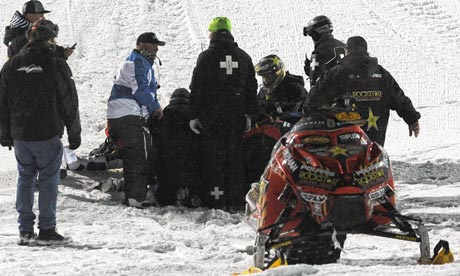
Caleb Moore was a top athlete in one of the most daring competitions ever devised for television: freestyle snowmobiling. But his death on Thursday from injuries sustained in last week's Winter X Games threw his sport – and the attending spectacle – into a harsh new light.

The 25-year-old died in a Colorado hospital from medical complications affecting his brain, a family spokesperson said.

"He will be truly missed and never forgotten," the family said in a statement. "The family wishes to express their deep gratitude for all the prayers and support they have received from all the fans, friends and family around the world that Caleb has inspired."

Moore crashed a minute into a routine in which he treated his 450-pound snowmobile like a broomstick, spinning around it in midair as he flew from ramp from ramp. He had been attempting a backflip with his machine, a trick he had performed many times. The X Games, which are produced by ESPN, are built on such excitement – and risk.

Moore's death was directly preceded by warnings that X Games athletes were taking life-threatening risks in the pursuit of victory – and the fame and potentially lucrative sponsorship deals that could follow.

Under the headline "It's only a matter of time before someone dies at the X-Games", Brent Rose, a writer for the sports site Deadspin, described his dismay at the multiple accidents – including Moore's – he witnessed at this year's games, held in Aspen. Rose's report was published Thursday morning, before news spread of Moore's death.

"As I watched these athletes fly over my head, it really hit home just how miraculous the zero-casualty rate was," Rose wrote. "'Maybe it's safer than it looks,' I thought for a brief moment. And then they started dropping like planes over Midway."

The X Games have been a huge success for sponsors and broadcasters – and a huge treat for fans – since their inception 18 years ago. With a focus on sports such as skateboarding and BMX that once lived on the commercial margins, the games gave athletes new professional avenues and fans new access to the excitement. The advent of the Winter X Games in 1997 shed a lucrative spotlight on snowboarding and snowmobiling.

For ESPN, the games have been a big success. This year's winter competition broke all records for viewership, drawing 35.4 million US viewers, including all live and repeat telecasts, according to official figures. Viewership among the key demographic, men aged 18-34, was up 16%.

With the global television audience for the games growing, ESPN plans to produce competitions at sites outside the United States for the first time next year. As with the Olympics, potential host cities will participate in a formal bidding process to host the games. Unlike the Olympics, the process will be arbitrated not by an international committee but by the games' for-profit broadcaster: ESPN.

In a statement Thursday, X Games officials expressed condolences and said Moore would be remembered "for his natural passion for life and his deep love for his family and friends".

Moore's agent, BC Vaught, told the Associated Press that Moore didn't believe his sport was too extreme, but rather "it was a lifestyle". He was good at it – along with ATV racing – and had accumulated a garage full of trophies.

Fellow snowmobile rider Levi LaVallee recently described Moore as a "fierce competitor".

"A very creative mind," LaVallee said. "I've watched him try some crazy, crazy tricks, and some of them were successful, some of them not so much. But he was first guy to get back on a sled and go try it again. It shows a lot of heart."

Related Posts Plugin for WordPress, Blogger...